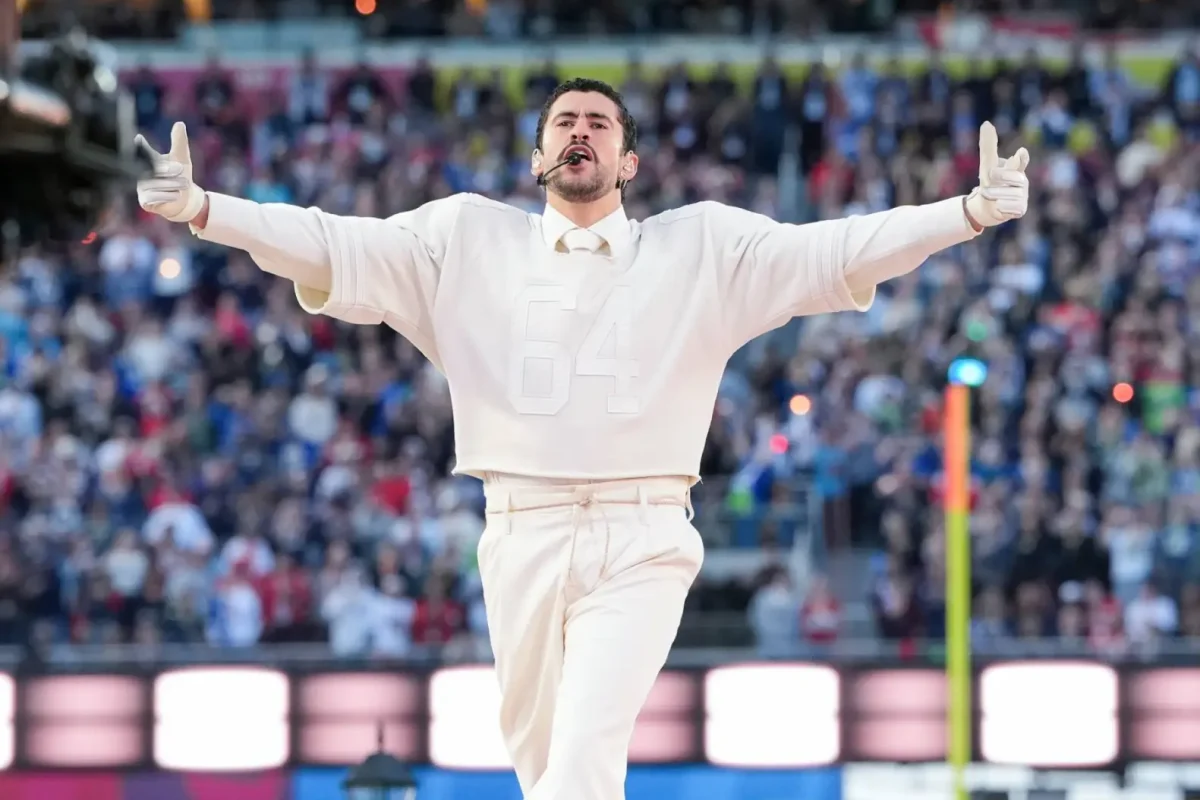
On February 8, the Super Bowl LX halftime show featured Bad Bunny and other artists to create a monumental performance for many to remember. His 13 minute performance gave a show that utilized rhetorical choices to share a story about his culture. Despite complaints and criticisms, Bad Bunny proved that he was worthy of performing at one of the biggest games in America.
At the beginning of his performance, viewers watched the camera walk through people working in sugar cane fields. While walking past the people, the camera pans to Bad Bunny singing “Tití Me Preguntó.” This was symbolic of the sugar plantations that have been common throughout the history of Puerto Rico, as a result of colonization. The laborers in the performance were wearing all-white clothes and straw “pava” hats, referencing iconic Puerto Rican countrymen, or jíbaro.
While singing “Tití Me Preguntó,” Bad Bunny walks pasts various scenes: friends at a coco frío stand, a group of older men playing dominoes, young women getting their nails done, and then a piragua (Puerto Rican shaved ice) stand where Bad Bunny is served the treat before he keeps walking. Piragua stands are iconic in Puerto Rican culture, often symbolizing community and nostalgia. This scene allows people to see that Puerto Rico and the United States do have things in common, which was a common complaint during the final decision of Bad Bunny performing.
On a screen above the halftime stage, viewers saw the animated character “Concho,” who is a key figure in Bad Bunny’s “DeBÍ TiRAR MáS FOToS” short film and album. “Concho” is an endangered crested toad, or a sapo concho. Bad Bunny’s short film, was following an elderly Bad Bunny, played by Puerto Rican actor, Jacobo Morales, who reminisced with his friend Concho as they looked through photos. The short film, and the album as a whole, is a symbol of the dangers of gentrification that are rapidly changing Puerto Rico.
Bad Bunny performs many songs, such as “Yo Perreo Sola,” “Safaera,” “Party,” and “Voy a Llevarte Pa’ PR” from the rooftop of the famed “Casita.” These types of houses are common in Puerto Rico, as they are built to withstand hurricanes, in comparison to wood-style homes. The home was pink, which is frequent in Puerto Rico because of their traditional brightly colored homes, had shuttered windows, and a carved wood door.
The portion of the halftime show that featured a wedding, plus Lady Gaga and Bad Bunny singing “Baile Inolvidable,” was a partial replica of Castillo San Felipe del Morro, more commonly known as El Morro. This 16th-century Spanish-built stone fort borders part of the coast of the historic areas of Puerto Rico’s capital city, San Juan. El Morro is now a national symbol of Puerto Rico so much so that it often appears on license plates, in addition to being a U.S. National Park and a UNESCO World Heritage Site.
As Bad Bunny performed his political-party track “El Apagón,” viewers saw the same cane workers from the start of the show hanging from electric poles. “El Apagón” literally means “blackout.” The symbolic message comes from the outcome of Hurricane Maria, which caused nearly a year long blackout in Puerto Rico. His song directly spoke about the United States’ inhumane response to the severity of the storm. The situation was so dire that many citizens taught themselves basic electrical skills, and risked their lives climbing up electric poles in order to restore power momentarily.
At the end of the show, Bad Bunny shouted “God bless America!” and preceded to name every country in the Americas from Canada in the north to Chile in the south. Following that shout, groups of people carrying flags of every country and territory in the Americas surrounded him. Following listing all the countries, Bad Bunny holds up a football that he has been carrying on and off throughout the performance to the camera to show the words “Together we are America,” and said, “Sequimos aqui” which translates to “We’re still here.” This showcase allowed Bad Bunny to proudly declare that America is much more than the United States, and the United States would not be what it is without Latino and Caribbean immigrants.
This incredible show was both entertaining and symbolic, allowing everybody to enjoy his performance. This was a big step to including various heritages into a performance that many Americans anticipate every year.