
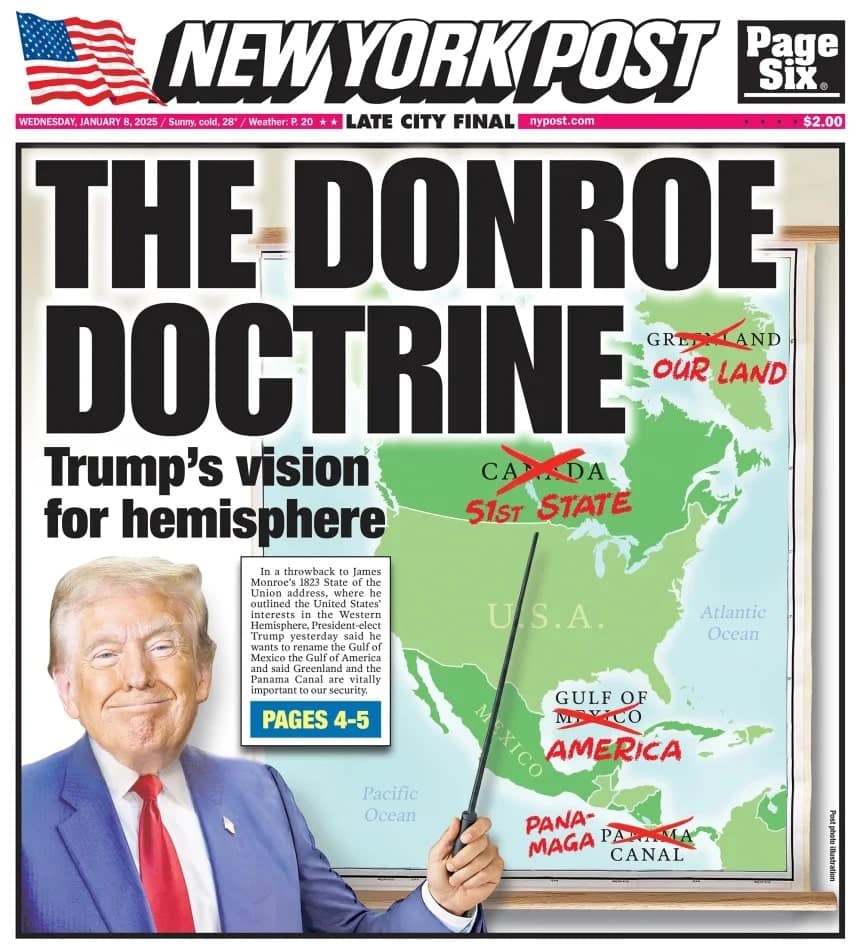
President Donald Trump has long had an obsession with Greenland. In 2019, he attempted to buy the island from Denmark, who controls it. Trump referred to the issue that year as “essentially a large real estate deal”, according to the Guardian. He was, however, told it was not for sale, according to the BBC. Trump’s second term has brought with it another onslaught on acquisition attempts, which at first glance may be difficult to understand.
The first problem with a U.S. acquisition of Greenland is that, although its government has autonomy over domestic issues, it remains a territory of the Kingdom of Denmark, who controls its defense and foreign policy. Denmark is a NATO ally of the U.S., which means that an American attempt to seize control of the island would end the alliance. According to the Arctic Institute, “The moment the United States uses military force, the NATO alliance is history.” The dissolution of NATO would be a worst-case outcome for U.S. soft power, as NATO has proven to be extremely effective at stymying Russian interests in the North Atlantic and Europe.
Trump, however, might not agree. According to the BBC, Trump insisted during the World Economic Forum that the U.S. is “treated very unfairly” by NATO and gets very little despite “[giving] so much.”
Even if Trump doesn’t see NATO as an obstacle, his drive to take over Greenland might still seem perplexing. After all, what does the island have to offer?
Clearly, Trump believes the U.S. needs Greenland for some purpose, as he told the World Economic Forum that he is seeking “immediate negotiations” to acquire Greenland for national security reasons. He did insist that he “won’t use force”.
There are multiple answers to this question from Trump’s perspective, which have varying validity in terms of their ability to protect U.S. interests.
One of these reasons is Greenland’s natural resource deposits. It is true that Greenland has plentiful resources including rare earth minerals, iron, uranium, and possibly substantial amounts of oil and gas. There is at least one deposit of niobium, which is used in jet engines and pipelines. Greenland would bring some economic benefits to the U.S., but that may not be worth breaking the NATO alliance. According to the Arctic Institute, the answer to that question is a resounding “no”.
According to the Arctic Institute, “The U.S. does not need to have sovereignty over Greenland to access resources. Nor is it ‘the U.S.’ that extracts resources, it is companies. There are other parts of the Arctic, such as Alaska, that have great untapped mineral potential.”
The second reason is simpler, and it is national security. “It’s so strategic right now,” Trump told CBS reporters on January 4, claiming “Greenland is covered with Russian and Chinese ships all over the place. … We need Greenland from the standpoint of national security, and Denmark is not going to be able to do it.”
This argument has merit at face value, as Greenland is positioned between the United States and Russia. However, the strategic situation is quite different than Trump claims.
The Arctic Institute puts it quite succinctly: “Do Russian naval vessels sail around Greenland? No, they sail in the Barents Sea around Svalbard and along the Norwegian coast to show that they can stop any attacks on the nuclear weapons on the Kola Peninsula. There may be some Russian submarines sailing around Greenland, but hardly more there than around the Canadian islands in the north or around Iceland a little further south…China is interested in using the Arctic as an arena to project power and at the same time earn a few yuan, interspersed with strategic positioning in anticipation of further melting of the ice. [But] do Chinese ships sail around Greenland? No, they mainly sail to and from Russia with raw materials, and they sail outside Alaska to hold military exercises, to conduct research, and to fish.”
On this claim, Trump falls flat. There is no credible evidence to suggest that Denmark has allowed the Russian or Chinese militaries to intrude on Greenland. In fact, the only thing Denmark has failed to do is establish an early-warning base in Greenland to warn of incoming Russian nuclear missiles. That is why the U.S. has already established Pituffik base in northwestern Greenland to do just that, making it clear that all relevant U.S. national security interests are already serviced by the current situation in Greenland.
Clearly, the current threats to Greenland’s sovereignty are a threat not only to Greenland and Denmark but U.S. interests in the form of the NATO alliance and its soft power on the global stage.