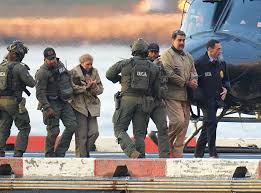
On the morning of January 3, 2026, the United States captured Venezuelan president Nicolás Maduro in Operation Absolute Resolve, a large-scale strike on Venezuela’s capital, Caracàs. Along with the capture of Maduro, the U.S. also made use of, according to the Council on Foreign Relations (CFR), 150 aircraft to strike multiple targets in the capital. The move was an escalation of the larger Operation Southern Spear, an ongoing U.S. military campaign in the Caribbean and South America. Maduro has since been taken to federal court in New York City, where he pleaded not guilty to drug, weapons, and narco-terrorism charges. His vice president, Delcy Rodríguez, has been sworn in as acting president, but questions remain surrounding Venezuela’s stability and governance.
Maduro’s capture was executed by members of the U.S. army’s Delta Force and CIA operatives, according to the CFR, and occurred without any American casualties. Reactions have been mixed internationally, though not unexpected. According to the same source, nearby nations Brazil, Cuba, and Colombia have issued condemnations of the strike, and Uruguay and Chile have voiced concerns about the use of military force. U.S. adversaries Russia and China have, expectedly, condemned Maduro’s capture.
On the other hand, Argentinian president (and ally of President Donald Trump) Javier Milei praised the move, saying that “freedom moves forward” as a result, according to the CFR. Ecuador, El Salvador, and Trinidad and Tobago all expressed similar sentiments of support for the U.S. intervention. In Venezuela itself, the reaction has been positive. This is especially true for opposition leader Maria Machado, who, according to the CFR, said that the US has fulfilled its promise to uphold the law. A small minority of Venezuelans have protested Maduro’s capture, but according to the BBC, most Venezuelans are newly hopeful about their nation’s future.
Dina, a resident of Venezuela, told the BBC that for now, she was grateful to the US for “taking Maduro out of here” because she “at least can see some light at the end of the tunnel again.”
In spite of this celebration, Venezuela’s future remains tense. Other than Maduro, Venezuela’s dictatorial regime remains largely intact. It is difficult to say whether the removal of Maduro will meet with any lasting change in a government that, in 2024, refused to cede power after a presidential election, according to the CFR. Vice President Rodríguez, despite stating that she will work with the U.S., played a direct role in Maduro’s authoritarian regime and has faced U.S. sanctions herself. Even in the case that governance does improve, however, Venezuela’s problems would not be fully resolved.
Along with censorship and repression of its citizens, Maduro’s regime was also well-known for the collapse of the Venezuelan economy. According to the Economics Observatory, Venezuela’s standard of living dropped 74% between 2013 and 2024, the fifth-largest drop ever recorded.
In spite of being home to a crude oil reserve of 303 billion barrels (17% of the global supply, according to the CFR), Venezuela has not been able to build a functioning oil industry. 2019 U.S. sanctions targeted at Maduro’s dictatorial regime played a large role in this, along with hyperinflation caused by a 2014 fall in oil prices from $100 to $40 a barrel. In 2019, Venezuela exported 1.5 million barrels of oil. In 2024, the rate was only 850,000 barrels, which was actually a drastic improvement on a 2020 low of 337,000 barrels.
The U.S. has claimed it will rebuild Venezuela’s oil industry, with Energy Secretary Chris Wright announcing on January 7 that Washington intends to oversee the sale of Venezuela’s oil “indefinitely.” Trump has said that U.S. oil companies are “ready and willing” to enter the country, though energy companies have so far expressed skepticism about the prospect, according to the CFR. Without a comprehensive plan, the future of Venezuela’s economy is uncertain.
The intentions of the Trump administration are suspect in the first place. CFR Senior Fellow Brad W. Setser said in a response to the operation that “President Trump has repeatedly said that he wants to secure Venezuela’s oil for U.S. firms, and there is no reason to doubt that expanding U.S. firms’ access to Venezuela’s heavy oil and compensation for Venezuela’s previous nationalizations has been at the forefront of his thinking.” This makes it clear that the U.S.’s increased interest in Venezuela may be partially due to an interest in its natural resources.
The use of military force in Venezuela may also be a response to Russian and Chinese influence in the nation. Both nations have shown interest in Venezuela’s oil. In fact, Reuters reported on January 7 that a Venezuelan tanker ship attempting to escape a U.S. blockade was found to have been bound for Russia. Further, the very air defense systems that the U.S. evaded to capture Maduro were supplied to Venezuela by China. The capture of Maduro and the attempt to seize control of the oil industry, therefore, can be seen as a deterrence to both U.S. adversaries. The BBC reported that whether this will be effective is unknown, and it will largely depend on the U.S.’s ability to effectively control Venezuela’s oil economy.
Still another repercussion of the U.S. success in Venezuela is its repercussions for an unlikely territory: Greenland, which Trump has repeatedly insisted must become a part of the US. CNN reports that the success of Absolute Resolve has influenced Trump’s brazenness.
Further, Trump told CNN in an interview that the US needs Greenland “from the standpoint of national security.”
Greenland is indeed positioned strategically to deter Russia and China from action in the region, but it must be recalled that the current owner of Greenland is Denmark, a NATO ally of the U.S. This agenda has been criticized as imperialistic by those opposed to it.
Danish Prime Minister Mette Frederiksen reiterated to CNN on January 5 that she had already “made it very clear where the Kingdom of Denmark stands, and that Greenland has repeatedly said that it does not want to be part of the United States.” Denmark has gone so far as to warn that the US acquisition of Greenland would be the end of NATO, a threat with serious global repercussions. It also throws the U.S.’s operations in Venezuela into question: if Trump wants to take over Greenland, he may make a similar bid for South American soil in the future, especially if President Rodríguez does not cooperate with the administration.
It raises the question: is the U.S’s goal the welfare of the Venezuelan people, the nation’s oil-rich nature, deterrence of Russia and China, or imperialistic ambitions? It is difficult, or perhaps impossible, to isolate a cause, and it is quite likely that multiple or all of these factors were key in the decision to capture Maduro. The strike strains the U.S.’s relationships with many key regional allies, and the resulting insistence on Greenland’s acquisition has thrown the very existence of NATO, one of the most important alliances in the geopolitical world, into jeopardy. The consequences may not be fully evident for months or years, but it is clear that an event of true historical significance occurred in the morning of January 3, 2026.